
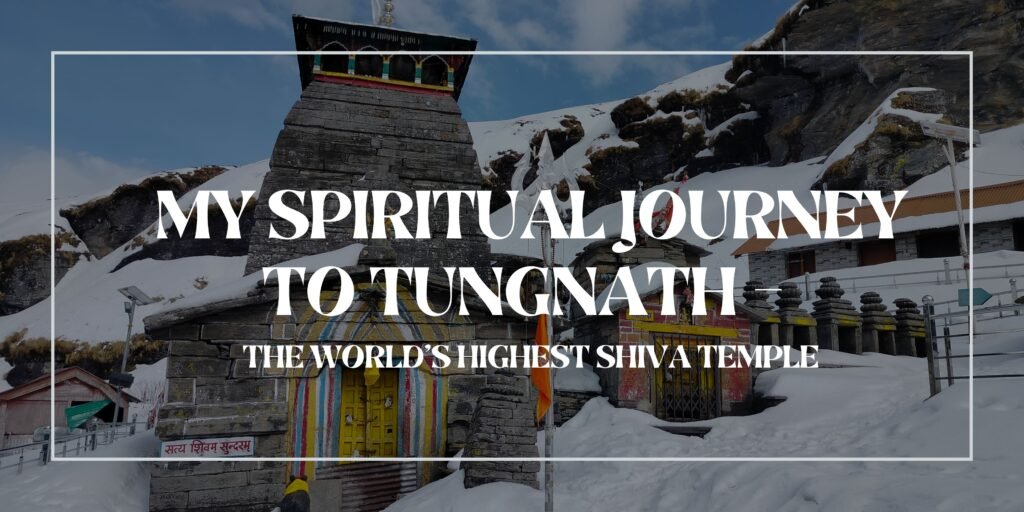
Some journeys are planned. Mine was not. It began with a feeling I couldn’t describe. Life had become fast, noisy, and repetitive. Days were full, yet I felt something missing. I wasn’t looking for adventure or a holiday—I needed stillness. Somewhere in that quiet search, Tungnath temple came to my mind. Little did I know, this journey would change the way I saw faith, nature, and myself.
The First Step Toward the Mountains
Tungnath temple is in the Garhwal Himalayas of Uttarakhand. It sits at an altitude of 3,680 meters, making it the world’s highest Shiva temple. It is also part of the sacred Panch Kedar temples. But beyond these facts, Tungnath temple has a spiritual pull that words cannot fully capture.
I started my journey from Chopta, a quiet hill station surrounded by green meadows and forests. There were no crowded markets, no loud tourist spots. Only fresh mountain air and the gentle sound of the wind through trees. That morning, standing at the base of the trek, I felt unusually calm. The mountains seemed to ask me to leave behind not just my luggage, but also my worries.
Trekking to Tungnath in Silence
Tungnath is about 3.5 kilometers to the trek, not very long, but deeply meaningful. The trail climbs steadily, weaving through rhododendron forests and open stretches. Himalayan peaks appear suddenly, breathtaking and dramatic. My breathing grew heavier with each step, yet my thoughts became lighter.
I noticed something strange—I wasn’t rushing. There was no need to reach quickly. I walked slowly, pausing often. Sometimes to catch my breath, sometimes to enjoy the view. The mountains didn’t feel like scenery—they felt like companions. The silence was comforting.
At times, the only sound I heard was my own footsteps. In that quiet, my mind started to settle. Thoughts that usually raced slowed down. The trek felt less like walking and more like moving meditation.
Stories Carved in Stone
As I climbed higher, I remembered the legends of Tungnath. After the Mahabharata war, the Pandavas sought Lord Shiva to ask for forgiveness. Shiva, unwilling to forgive them immediately, took the form of a bull and vanished into the earth. Different parts of his body appeared at five locations, and Tungnath is where his arms emerged.
Thinking about this added depth to my journey (Tungnath Temple). I wasn’t just trekking; I was walking a path shaped by centuries of devotion. Pilgrims had traveled this same route long before me, each carrying their prayers and hopes.
Reaching Tungnath Temple
When the Tungnath temple appeared, it did not overwhelm me. It was quiet, modest, and strong. Built from stone, it fit perfectly into the Himalayan backdrop.
Inside the Tungnath temple, I felt peace immediately. The air was different—fresh and calm. There were no loud crowds. People whispered or stayed silent. I removed my shoes and felt the cold stone under my feet. That simple act grounded me.
I closed my eyes and breathed slowly. I didn’t ask for wealth, success, or miracles. I just allowed myself to be. In that moment, I realized how rarely we pause without expectation. Tungnath gave me that space.
Faith Without Words
Spirituality doesn’t need to be loud. At Tungnath, I felt it strongly. There were no rituals or grand displays. Yet, the energy was undeniable.
Surrounded by mountains older than time, I felt surrender—not of weakness, but of trust. Not everything in life needs to be controlled. Some things are meant to be experienced. I left a small part of my worries at the feet of the mountains.
The Climb to Chandrashila
After visiting Tungnath, I continued to Chandrashila Peak. The trail was steeper, the wind colder, and my legs heavier. But the promise of the summit urged me onward.
At the top, the view was surreal. A 360-degree panorama of snow-capped peaks stretched endlessly. I stood there silently, letting the wind brush past me. The noise of everyday life felt distant and unimportant. At that moment, I felt connected—to the mountains, to nature, and to myself.
The Journey Back
Descending to Chopta, the trail felt familiar, almost comforting. My perspective had shifted. Problems that once seemed large now felt small. My legs were tired, but my heart was full.
As the sun set, painting the sky in soft orange and pink, I realized that Tungnath hadn’t given me answers—it had given me clarity. Peace doesn’t come from constant activity, but from moments of stillness.
A Journey That Stays Within
My journey to Tungnath didn’t end when I returned home. It stayed with me—in my thoughts, my breathing, and in the way I began to slow down and listen.
Tungnath taught me that spirituality is not about escaping the world. It is about connection—to nature, to silence, and to yourself. You don’t need to be deeply religious to feel its presence. You only need an open heart.
Sometimes, the most meaningful journeys don’t change your location—they change your perspective. Tungnath changed mine forever.